

MALONE, KALI — Does Spring Hide its Joy

More Info
»Does Spring Hide Its Joy« is an immersive piece by composer Kali Malone featuring Stephen O’Malley on electric guitar, Lucy Railton on cello, and Malone herself on tuned sine wave oscillators. The music is a study in harmonics and non-linear composition with a heightened focus on just intonation and beating interference patterns. Malone’s experience with pipe organ tuning, harmonic theory, and long durational composition provide prominent points of departure for this work. Her nuanced minimalism unfolds an astonishing depth of focus and opens up contemplative spaces in the listener’s attention.
»Does Spring Hide Its Joy« follows Malone’s critically acclaimed records. Her collaborative approach expands from her previous work to closely include the musicians Stephen O’Malley & Lucy Railton in the creation and development of the piece. While the music is distinctly Malone’s sonic palette, she composed specifically for the unique styles and techniques of O’Malley & Railton, presenting a framework for subjective interpretation and non-hierarchical movement throughout the music.
»Does Spring Hide Its Joy« is a durational experience of variable length that follows slowly evolving harmony and timbre between cello, sine waves, and electric guitar. As a listener, the transition between these junctures can be difficult to pinpoint. There’s obscurity and unity in the instrumentation and identities of the players; the electric guitar's saturation timbre blends with the cello's rich periodicity, while shifting overtone feedback develops interference patterns against the precise sine waves. The gradual yet ever-occurring changes in harmony challenge the listener’s perception of stasis and movement. The moment you grasp the music, a slight shift in perspective guides your attention forward into a new and unfolding harmonic experience.
»Does Spring Hide Its Joy« was created between March and May of 2020. During this unsettling period of the pandemic, Malone found herself in Berlin with a great deal of time and conceptual space to consider new compositional methods. With a few interns left on-site, Malone was invited to the Berlin Funkhaus & MONOM to develop and record new music within the empty concert halls. She took this opportunity to form a small ensemble with her close friends and collaborators Lucy Railton & Stephen O’Malley to explore these new structural ideas within those various acoustic spaces. Hence, the foundation was laid for »Does Spring Hide Its Joy«.
In Kali’s own words: “Like most of the world, my perception of time went through a significant transformation during the pandemic confinements of spring 2020. Unmarked by the familiar milestones of life, the days and months dripped by, instinctively blending with no end in sight. Time stood still until subtle shifts in the environment suggested there had been a passing. Memories blurred non-sequentially, the fabric of reality deteriorated, unforeseen kinships formed and disappeared, and all the while, the seasons changed and moved on without the ones we lost. Playing this music for hours on end was a profound way to digest the countless life transitions and hold time together.”
»Does Spring Hide Its Joy« has since been performed live on many European stages, in durations of sixty and ninety minutes. Including at the Schauspielhaus in Zürich, the Bozar in Brussels, Haus Der Kunst in Munich, and the Munch Museum in Oslo. Concerts are forthcoming at Unsound Festival in Krakow, Mira Festival in Barcelona, the Venice Biennale, and the Purcell Room at the Southbank Center in London.
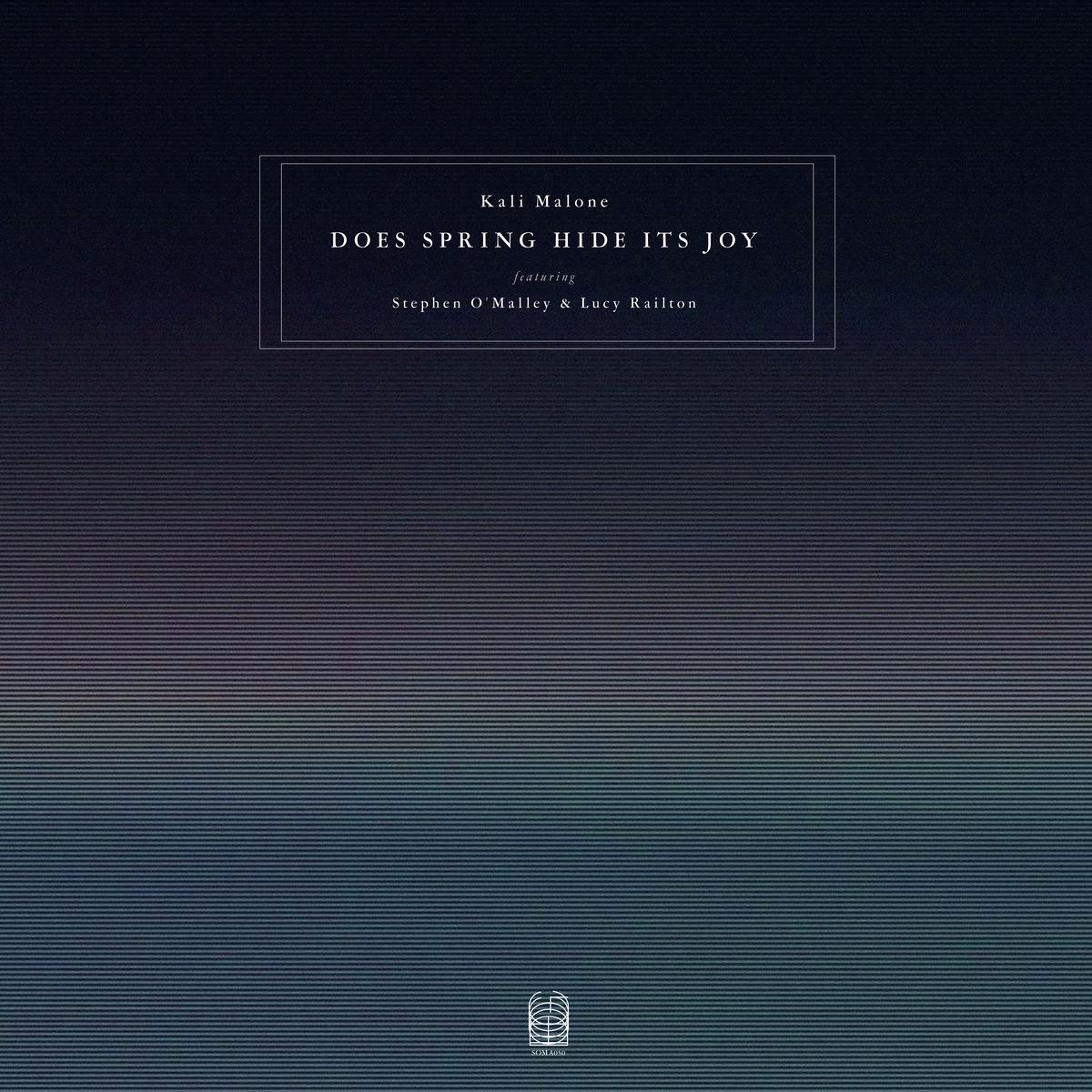
In addition to live concerts, the Funkhaus recordings of »Does Spring Hide Its Joy« have evolved in parallel as a site-specific sound installation. Malone has also invited the video artist Nika Milano to create a custom analog video work that interprets and accompanies the musical score as a fourth player, creating a visual atmosphere inspired by the sonic principles of the composition. Eight sequential video stills from Milano’s work are featured in the album artwork.
»Does Spring Hide Its Joy« is packaged in a heavyweight laminated jacket with full-color printed inner sleeves with artwork by Nika Milano. Mastered by Stephan Mathieu and cut at Schnittstelle Mastering, the record is pressed in perfect sound quality by Optimal in Germany.
https://kalimalone.bandcamp.com/album/does-spring-hide-its-joy
Does Spring Hide Its Joy ist ein immersives Stück der Komponistin Kali Malone mit Stephen O'Malley an der E-Gitarre, Lucy Railton am Cello und Malone selbst an gestimmten Sinusoszillatoren. Die Musik ist eine Studie über Obertöne und nichtlineare Komposition mit besonderem Augenmerk auf gerechter Intonation und schlagenden Interferenzmustern. Malones Erfahrungen mit der Stimmung von Pfeifenorgeln, der Harmonielehre und langer Kompositionen sind wichtige Ausgangspunkte für dieses Werk. Ihr nuancierter Minimalismus entfaltet eine erstaunliche Tiefenschärfe und eröffnet kontemplative Räume in der Aufmerksamkeit des Zuhörers. Does Spring Hide Its Joy ist eine Dauererfahrung von variabler Länge, die einer sich langsam entwickelnden Harmonie und Klangfarbe zwischen Cello, Sinuswellen und E-Gitarre folgt. Für den Hörer ist der Übergang zwischen den einzelnen Abschnitten oft schwer auszumachen. Das gesättigte Timbre der E-Gitarre vermischt sich mit der reichen Periodizität des Cellos, während die sich verschiebenden Oberton-Rückkopplungen Interferenzmuster mit den präzisen Sinuswellen entwickeln.
»Does Spring Hide Its Joy« follows Malone’s critically acclaimed records. Her collaborative approach expands from her previous work to closely include the musicians Stephen O’Malley & Lucy Railton in the creation and development of the piece. While the music is distinctly Malone’s sonic palette, she composed specifically for the unique styles and techniques of O’Malley & Railton, presenting a framework for subjective interpretation and non-hierarchical movement throughout the music.
»Does Spring Hide Its Joy« is a durational experience of variable length that follows slowly evolving harmony and timbre between cello, sine waves, and electric guitar. As a listener, the transition between these junctures can be difficult to pinpoint. There’s obscurity and unity in the instrumentation and identities of the players; the electric guitar's saturation timbre blends with the cello's rich periodicity, while shifting overtone feedback develops interference patterns against the precise sine waves. The gradual yet ever-occurring changes in harmony challenge the listener’s perception of stasis and movement. The moment you grasp the music, a slight shift in perspective guides your attention forward into a new and unfolding harmonic experience.
»Does Spring Hide Its Joy« was created between March and May of 2020. During this unsettling period of the pandemic, Malone found herself in Berlin with a great deal of time and conceptual space to consider new compositional methods. With a few interns left on-site, Malone was invited to the Berlin Funkhaus & MONOM to develop and record new music within the empty concert halls. She took this opportunity to form a small ensemble with her close friends and collaborators Lucy Railton & Stephen O’Malley to explore these new structural ideas within those various acoustic spaces. Hence, the foundation was laid for »Does Spring Hide Its Joy«.
In Kali’s own words: “Like most of the world, my perception of time went through a significant transformation during the pandemic confinements of spring 2020. Unmarked by the familiar milestones of life, the days and months dripped by, instinctively blending with no end in sight. Time stood still until subtle shifts in the environment suggested there had been a passing. Memories blurred non-sequentially, the fabric of reality deteriorated, unforeseen kinships formed and disappeared, and all the while, the seasons changed and moved on without the ones we lost. Playing this music for hours on end was a profound way to digest the countless life transitions and hold time together.”
»Does Spring Hide Its Joy« has since been performed live on many European stages, in durations of sixty and ninety minutes. Including at the Schauspielhaus in Zürich, the Bozar in Brussels, Haus Der Kunst in Munich, and the Munch Museum in Oslo. Concerts are forthcoming at Unsound Festival in Krakow, Mira Festival in Barcelona, the Venice Biennale, and the Purcell Room at the Southbank Center in London.
In addition to live concerts, the Funkhaus recordings of »Does Spring Hide Its Joy« have evolved in parallel as a site-specific sound installation. Malone has also invited the video artist Nika Milano to create a custom analog video work that interprets and accompanies the musical score as a fourth player, creating a visual atmosphere inspired by the sonic principles of the composition. Eight sequential video stills from Milano’s work are featured in the album artwork.
»Does Spring Hide Its Joy« is packaged in a heavyweight laminated jacket with full-color printed inner sleeves with artwork by Nika Milano. Mastered by Stephan Mathieu and cut at Schnittstelle Mastering, the record is pressed in perfect sound quality by Optimal in Germany.
https://kalimalone.bandcamp.com/album/does-spring-hide-its-joy
Does Spring Hide Its Joy ist ein immersives Stück der Komponistin Kali Malone mit Stephen O'Malley an der E-Gitarre, Lucy Railton am Cello und Malone selbst an gestimmten Sinusoszillatoren. Die Musik ist eine Studie über Obertöne und nichtlineare Komposition mit besonderem Augenmerk auf gerechter Intonation und schlagenden Interferenzmustern. Malones Erfahrungen mit der Stimmung von Pfeifenorgeln, der Harmonielehre und langer Kompositionen sind wichtige Ausgangspunkte für dieses Werk. Ihr nuancierter Minimalismus entfaltet eine erstaunliche Tiefenschärfe und eröffnet kontemplative Räume in der Aufmerksamkeit des Zuhörers. Does Spring Hide Its Joy ist eine Dauererfahrung von variabler Länge, die einer sich langsam entwickelnden Harmonie und Klangfarbe zwischen Cello, Sinuswellen und E-Gitarre folgt. Für den Hörer ist der Übergang zwischen den einzelnen Abschnitten oft schwer auszumachen. Das gesättigte Timbre der E-Gitarre vermischt sich mit der reichen Periodizität des Cellos, während die sich verschiebenden Oberton-Rückkopplungen Interferenzmuster mit den präzisen Sinuswellen entwickeln.