

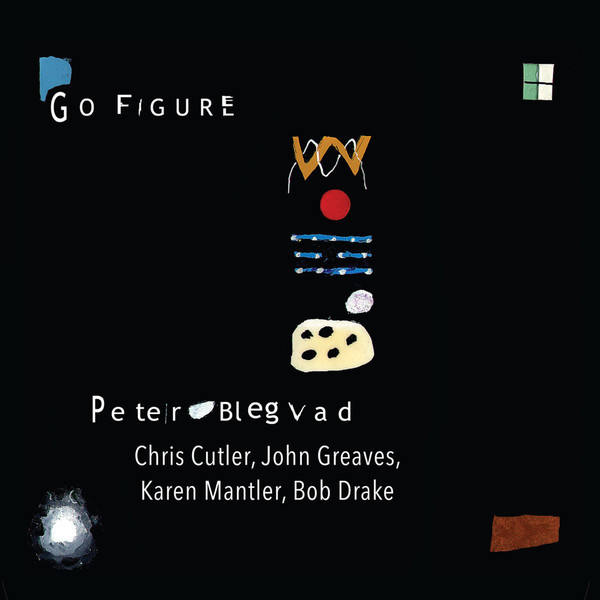
BLEGVAD, PETER — Go Figure

More Info
"After 19 years, Go Figure marks the Peter Blegvad Trio's return to the studio, in supernal form and now a quintet with Karen Mantler and Bob Drake. Peter, John and Chris first met when Henry Cow was touring with Faust, in 1972. Peter was on secondment from his own group Slapp Happy, and in the following year Henry Cow and Slapp Happy merged, making two LPs before they separated again. When John Greaves left Henry Cow in 1976, he joined Peter in New York where they wrote and recorded Kew.Rhone. Peter and John have continued to work together, on-and-off, ever since. After making two solo LPs for the still vaguely experimental Virgin Records, Peter's next LP, Downtime, was made independently by ReR -- and the core players wound up being the Peter Blegvad Trio. Bob Drake first became involved during the second trio recording, Just Woke Up, which he mixed and mastered. Karen joined the trio in 2002 for a festival in Ferrara. Bob's first stage appearance with the band came ten years later, in 2012, at the RIO festival in Carmaux. ReR has been releasing the Blegvad working group's records for 37 years and this is the fourth so far. They don't come easy."
peterblegvad.bandcamp.com/album/go-figure
"Artist, poet, illustrator, philosopher, cartoonist – so broad are Peter Blegvad’s other interests, and so protean his muse, that one sometimes has to wait for years for his attention to turn again to music. But the payoff lies in the way that those other pursuits feed back into his music in the form of songs that exult in their uniqueness. Blegvad is one of pop’s very few “true originals” whose work always bears out that status.
Probably best known for Leviathan, his long-running Independent On Sunday cartoon strip, Blegvad brings a similar level of abstruse conjecture and whimsical wordplay to his lyrics, whether he’s musing, in “Sven”, upon a leathery ancient corpse preserved “in a Finnish fen”, or offering a grim reflection, in “Mind The Gap”, on how a terrorist bomb destroys the collective isolation of Tube travellers: “Blown apart and blown together, now the two of us were one”.
However, it’s not usually that dark: “Too Much” is a jaunty ragtime rumination on excess, slipping from familiar physical indulgence to more abstract realms (“too much sturm, too much drang, too much yin, too much yang”); and in “My Father’s Face”, Blegvad pirouettes on the cusp of whimsy and something more sinister, relating how he once drew his sleeping father, then erased his face. But perhaps his most elegant and amusing aesthetic reflection resides in “Way To Play The Blues”, where he uses John Cage’s epigram “I have nothing to say and I am saying it, and that is poetry as I need it” as inspiration for a (probably apocryphal) tale of the Stones asking Blegvad to help them understand the way to play the blues, a question he denudes of dues, and ultimately of volition.
Blegvad’s band, comprising various Henry Cow alumni and sundry avant-gardists, provides flexible support for his musings, from the sinister cod-reggae shuffle of “Penny Black”, about a cursed stamp, to the more indefinable brew of languid, jazzy raunch-rock conjured to convey the enigmatic villain of “Had To Be Bad”. Elsewhere, there’s an aptly Kevin Ayers-y air to the Provençal tableau “Cote D’Azur”, while “God Detector” adopts a suitably Dylanesque tone for the tale of a man with a machine he claims can trace divinity – for which, of course, he searches in vain amongst humanity.
If there is a unifying theme to the album, it’s probably to be found in the reflections upon dissipation and the futility of ambition in songs such as “Simon At The Stone” and “Winner Came There None” – songs which don’t so much disparage notions of being and doing, as prompt enquiry about the limitless ranges of experience, and their comparative values." [The Independent]
peterblegvad.bandcamp.com/album/go-figure
"Artist, poet, illustrator, philosopher, cartoonist – so broad are Peter Blegvad’s other interests, and so protean his muse, that one sometimes has to wait for years for his attention to turn again to music. But the payoff lies in the way that those other pursuits feed back into his music in the form of songs that exult in their uniqueness. Blegvad is one of pop’s very few “true originals” whose work always bears out that status.
Probably best known for Leviathan, his long-running Independent On Sunday cartoon strip, Blegvad brings a similar level of abstruse conjecture and whimsical wordplay to his lyrics, whether he’s musing, in “Sven”, upon a leathery ancient corpse preserved “in a Finnish fen”, or offering a grim reflection, in “Mind The Gap”, on how a terrorist bomb destroys the collective isolation of Tube travellers: “Blown apart and blown together, now the two of us were one”.
However, it’s not usually that dark: “Too Much” is a jaunty ragtime rumination on excess, slipping from familiar physical indulgence to more abstract realms (“too much sturm, too much drang, too much yin, too much yang”); and in “My Father’s Face”, Blegvad pirouettes on the cusp of whimsy and something more sinister, relating how he once drew his sleeping father, then erased his face. But perhaps his most elegant and amusing aesthetic reflection resides in “Way To Play The Blues”, where he uses John Cage’s epigram “I have nothing to say and I am saying it, and that is poetry as I need it” as inspiration for a (probably apocryphal) tale of the Stones asking Blegvad to help them understand the way to play the blues, a question he denudes of dues, and ultimately of volition.
Blegvad’s band, comprising various Henry Cow alumni and sundry avant-gardists, provides flexible support for his musings, from the sinister cod-reggae shuffle of “Penny Black”, about a cursed stamp, to the more indefinable brew of languid, jazzy raunch-rock conjured to convey the enigmatic villain of “Had To Be Bad”. Elsewhere, there’s an aptly Kevin Ayers-y air to the Provençal tableau “Cote D’Azur”, while “God Detector” adopts a suitably Dylanesque tone for the tale of a man with a machine he claims can trace divinity – for which, of course, he searches in vain amongst humanity.
If there is a unifying theme to the album, it’s probably to be found in the reflections upon dissipation and the futility of ambition in songs such as “Simon At The Stone” and “Winner Came There None” – songs which don’t so much disparage notions of being and doing, as prompt enquiry about the limitless ranges of experience, and their comparative values." [The Independent]