| MENS, RADBOUD & MATTHIJS KOUW |
3/4
|
do-CD |
third collab release of the new dutch drone stars! => 'On their new album, MENS and KOUW use a 12-meter magnetic string instrument and a modular synthesizer to create 6 carefully tuned pieces. With a total playing time of over 2 hours, ‘3/4’ continues the long-form drone explorations first released on the LP ‘1’ on Moving Furniture Records in February 2017.." - a homage to the drone works of ELLEN FULLMAN, LA MONTE YOUNG and ALVIN LUCIER, ed. of 300 copies
|
2018 |
€15.00 |

|
| NILSEN, BJ [BJ NILSEN] |
Focus Intensity Power
|
LP |
the dutch MOVING FURNITURE REC. is known for ultra minimalistic drone releases, this is the first one from the prolific Swedish sound artist BJ NILSEN, who recorded five absorbing tracks using only electronics - modular synthesizers, tone generators and test / measurement instruments during a residency in Den Bosch, NL - " 'Focus Intensity Power' is an effective celebration of sustained tonal atmospheres, which amounts to evocative sounds in their purest form. Sublime." [Noise Receptor] - 300 copies
|
2018 |
€16.50 |
|
| COMES, MARTIJN |
Interrogation of the Crystalline Sublime
|
do-CD |
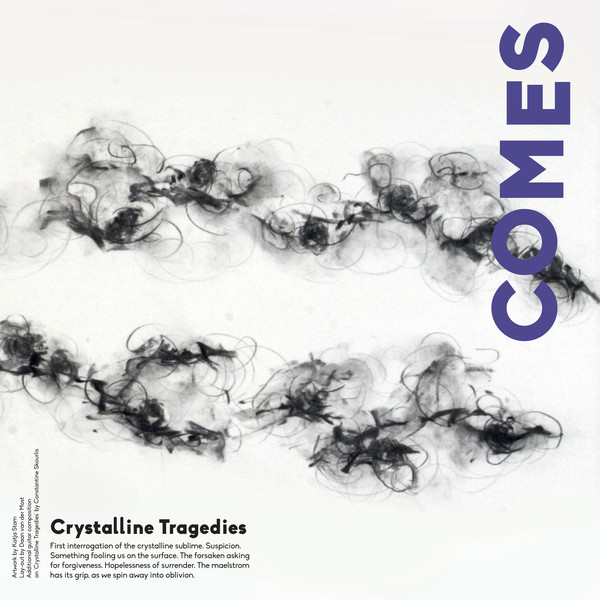
Martijn Comes - Interrogation Of The Crystalline Sublime
"The human being knows himself only insofar as he knows the world; he perceives the
world only in himself, and himself only in the world. Every new object, clearly seen,
opens up a new organ of perception in us."
— Johann Wolfgang von Goethe
I hear atmospheres, sound shapes, gestural narratives, spectral trajectories, stochastic rhythms and phasic space when I encounter an environment rich in sonic phenomena.
But in order to be open to this meta-sensory information, I must first get my ears out of the way. I don't listen with my ears but with an inner sensory apparatus, what Goethe called "organs of perception," that I have developed over the years.
Once opened to this world sound becomes something very different—it's as if one could previously only see in black and white and suddenly were able to see in color. One becomes a witness to a full range of qualities and events that were previously inaccessible.
The drone is not a steady-state sound but a constellation of sound objects that lie hidden beneath a simple surface. The listener can penetrate this surface when they allow time to exist in a space where the past and future collapse into an infinitesimal, yet infinite, moment.
Once inside this space the drone serves as a conduit to other planes of existence and explains why spiritualized cultures around the world have used the drone in their worship for millennia.
The drone integrates us with the supernal, a synesthesia takes place, all of our senses become a singular super-sense: there is no longer a distinction between sound and sight, or taste and touch.
When we experience the world in this way we see the vast web of interconnections and how we deprive ourselves when we divide the world into the narrow-band regions of our senses. It is by transcending these boundaries that we become more fully human and open to the richness the world has to offer us.
Kim Cascone - San Francisco, Nov 20 2015
https://movingfurniturerecords.bandcamp.com/album/interrogation-of-the-crystalline-sublime
"Martijn Comes is a Dutch composer specialising in new media, sound design and electro-acoustic composition. His hour-long deep-drone piece Interrogation of the Crystalline Sublime was published on the spectacular Drone Cinema 2015 Raspberry Pi (!) release – the kind of gem every dronehead will probably dream of, but with a price tag only few can afford.
So it’s a good thing that the Moving Furniture label decided to reissue this piece in a 2-CD version (ánd digital download of course): CD1 containing the hour-long Interrogation by Martijn Comes, and CD2 containing 8 remixes of that piece by Scant Intone, Mitchell Akiyama, Zeno van den Broek, Alberto Boccardi, Haarvöl, Juan Antonio Nieto, Giulio Aldinucci and Orphax.
Comes describes his work as ‘livingroom music’ (possibly distinguishing itself slightly from Erik Satie’s ‘Musique d’Ameublement’ (Furniture Music), which was meant to be played by live performers).
He set out to “write a piece that is equally meditative as it is harmonious and melodic, or at least it would hint at large subtle progressions of harmony, in a way that is magnetic to the imaginations, while the body remains in a meditative, relaxing state.”
It’s an immersive drone, with hints of a shore in the background, that gradually grows intense and inescapable in its first half and then gradually recedes again.
It is not often that drone material like this gets remix treatments by different artists, so it’s interesting to hear what other artists do with sonic material like this.
Some of the remixers focus on the drone aspect, emphasizing different frequencies thus altering the overall feel. Others filter out artefacts (which can hardly be heard in the original), or add their own material to create abstract electro-acoustic compositions that hardly seem related to the original. Some focus on emotional aspects, others take a more analytic approach. Most of them venture into sonic extremes, thus losing some of the ‘livingroom’ aspect of the original.
But each one of these remixes sound completely different – like if they were original compositions in the first place." [Ambientblog]
|
2017 |
€16.00 |
|
| D'INCISE |
Assemblee, Relache, Rejouissance, Parade
|
CD |
A collaborative release between Moving Furniture Records and INSUB.records. For Swiss customers we recommend to order from their shop insub.org
"Assemblée, relâche, réjouissance, parade" or another long, unspeakable, French, title (that would somehow translate as " Assembly, pause, rejoicing, parade").
Words that conjure ideas of music used in public, and social rituals.
The two distinct pieces experiment with the "bringing back" (re-injection?) of music into the experimental area. Do not see anything pretentious about it, it is rather a very personal path,
in the sense, among others, to not forbid certain aspects of music to make appearances, making bridges between conceptuality, and simplicity.
The first part, "L'Anglard de St-Donat", is constructed around a mazurka tune, a traditional dance from Central-France, played by Alfred Mouret, after his father François "L'Anglard".
But the four short "songs" are not to be seen as a reinterpretation (they're certainly not danceable), rather as a basis for d'incise's own research.
Solid drones and recurrent structures are built with recordings of bowed and struck metal objects and (sounds of various) instruments make counterpoints and quasi-melodic lines.
Then in "Le désir" the strategy is mirrored, electronics (detuned organs) make the rigid, and slightly awkward, context for the bowed metal sticks, tuned in relation to the electronics, to be played semi-improvised, and take a sort of soloist position, instabilities of both the objects and the gestures suddenly become open to interpretations and expressions. This piece is one of d'incise's actual solo live performances.
Composed, recorded and mixed by d'incise at Insub.studio, Geneva, 2017.
L'Anglard de St-Donat, assembled from recordings of bowed metallic objects, electric organ, harmonium, banjo & double bass
Le désir, bowed metallic sticks, performed live, over detuned/retuned organ backgrounds.
https://movingfurniturerecords.bandcamp.com/album/assemble-e-rela-che-re-jouissance-parade |
2019 |
€12.00 |
|
| DAVIS, GARETH & MERZBOW |
Broken Landscapes
|
LP |
Following on from their 2016 Moving Furniture release, Atsusaku, Broken Landscapes is a new collaboration between Gareth Davis (Oiseaux Tempete, Scanner, Elliott Sharp, Machinefabriek) and Merzbow, Japanese noise mastermind Masami Akita.
The theme of mechanical compression explored in the first album is taken further this time, being looked at in the context of the fears of mechanisation in the environment. A torrent of noise reimagines the North Sea wind farms, the industrialisation in Southern California and the fight for the survival of animals in their overrun habitats. Through three tracks, the sounds of these spaces are crushed and distorted, the sense of air being saturated by the shifting low-end drones and hum of machines, howling reeds and dense white noise pushing away the breathing space.
The acoustic sound almost suffocated beneath the dense mechanical sweep of furiously abusive digital cross-fire and unrelenting production line intensity. Hints of recognition as a voice from the environment shines through before moving abruptly back into the mechanical barrage of looping textures. Broken Landscapes is built on impenetrably thick walls of manipulated field recordings while the bass clarinet saturates the midrange, the massive swirling mesh of analogue and digital material painting pictures of the magnified terrain that surrounds us.
credits
released January 10, 2020
Bass clarinet and Electronics: Gareth Davis
Electronics: Masami Akita
Mastered by Jos Smolders at EARLabs
Lacquer cut by Andreas Lubich at LUPO
Sleeve by Rutger Zuydervelt
https://movingfurniturerecords.bandcamp.com/album/broken-landscapes
|
2020 |
€18.00 |
|
| DNMF (MACHINEFABRIEK & DEAD NEANDERTHALS) |
Smelter
|
LP |
Band: DNMF
Album: Smelter
Release date: April 30 2018
Formats: LP / CD / Cassette / Digital
Labels: Moving Furniture Records (LP, CD, Digital), Tartarus Records (Cassette, Digital)
Catalogue number: MFR054LP (LP), MFR054CD (CD), TAR095 (Cassette)
About the album:
Prolific experimental music purveyor Machinefabriek and droning free jazz combo Dead Neanderthals team up for the second DNMF album entitled 'Smelter'. Clocking in at nearly 40 minutes, Smelter is a highly dynamic amalgam of metal, drone and dark ambient and is hard to compare to anything else out there. Have a listen and enjoy!
Online
deadneanderthals.wordpress.com
deadneanderthals.bandcamp.com
facebook.com/deadneanderthals
machinefabriek.nu
machinefabriek.bandcamp.com
facebook.com/Machinefabriek-105289806168145/
www.movingfurniturerecords.com
movingfurniturerecords.bandcamp.com
facebook.com/movingfurniturerecords
tartarusrecords.com
facebook.com/TartarusRecords/
https://movingfurniturerecords.bandcamp.com/album/smelter
|
2018 |
€17.50 |
|
| FIND HOPE IN DARKNESS |
Locked so tightly in our Dreams
|
CD |
Moving Furniture Records is very proud to present the debut CD for Find Hope In Darkness, which is the alias of the 15 year old musician Glenn Dick from Ghent, Belgium.
Locked So Tightly In Our Dreams is his first CD release after two download only releases.
Where on his download releases he searches for a combination of broken beats and post-rock for Locked So Tightly In Our Dreams he explores his own boundaries in drone music and the darker sides of the ambient atmospheres.
Close your eyes and drown in the deep dark sounds of Find Hope In Darkness.
Locked So Tightly In Our Dreams is limited to 300 copies and comes in A5 sized artwork created by Helena Sanders.
www.movingfurniturerecords.com
|
2014 |
€12.00 |
|
| GUIONNET, JEAN-LUC & MIGUEL A. GARCIA |
Siticidelhous
|
CD |
listen: https://movingfurniturerecords.bandcamp.com/album/siticidelhous
Jean-Luc Guionnet & Miguel A. Garcia return to Moving Furniture Records with their second album Siticidelhous. Recorded during the same sessions at the conservatory Jesus Guridi in Vitoria Gasteiz in 2016 as their album Parkustomnie they further explore the possibilities of improvised church organ and electronic sounds.
Just like the previous release this album has two different sides. Due to the characteristics of the music and recordings when you play it at different volume levels you get totally different experiences. On a low level the music sounds as if the players really held back and the listening experience is very subtle, grabbing the listener’s attention completely. While when playing on loud volume all these new sounds appear creating an overwhelming experience that at moments just blows you away. Much hidden sounds between the notes.
An adventurous album which asks fullest concentration, but when given also delivers.
|
2018 |
€12.00 |
|
| HAARVÖL |
Ridge of Humming Spoils
|
CD |
The Portugese trio Haarvöl returns to Moving Furniture Records with the last part in their trilogy. After Bombinate and Peripherad Debris they conclude this journey with Ridge Of Humming Spoils.
"Psychoanalysis refers to the frontier as an empty signifier: it embodies an interior and an exterior. The last album of the trilogy we set out to puts us there. On top of a vast set of remains whispering to us. Remains, because they have been left behind, because they are no longer useful. And yet, usefulness is something that tells little or nothing to us, artists. Quite the opposite. For this very reason, this new album is made up of these testimonies that whisper their condition very strongly to us. From the top of this pile of whispering remains we have achieved something that is precious to us: time, in its three dimensions, and not enclosed in that kind of perpetual present where they want to force us into, in a timeless time.
Here, at the top of this ridge, we can look back and ahead. Because it interests us. Because we want to.
We started the trilogy in a noisy place, but still with views to the center, we walked towards the periphery and now we find ourselves at the top of an empty signifier, on a border metaphor. It would have to be this way in a project where the important thing is the escape from formulas and repetitions: maintaining coherence without falling into concessions has always been our motto. Naturally, as we are at the border, its outside is much more appealing to us (it has always been this way until today. The continuous migrations of the past and of the tragic present prove it so) with its uncertainties and unfamiliarity, but also with the certainty of the difference. Is this not, after all, the appeal of art: that attraction for the unknown? Therefore, we have a certainty that is continually whispered to us by these remains that can be heard now: we will move on to the outer side, of course. The border, here made up of this ridge of whispering remains/humming spoils, has naturally closed the cycle. That is what borders are for: to interrupt, to limit; ultimately, to try to block. In our case, to be crossed affirmatively – as we well know, there are no walls that can prevent it.
We will continue exploring the sounds that interest us: sounds that contemplate time and attention as decisive elements, sounds that can appear as specters, asynchronous, almost incongruous with this time with no time to have time, this autophagic time. But already outside. In a utopia of an exile that carries no form of negativity, it affirms itself as positive otherwise because it allows the necessary distance to a placement that wants to be creatively critical.
One last note for something that sometimes appears in a completely innocuous way: the track titles. That is not our case. Here, just as it has been common throughout the rest of our discography, the titles we choose try to connect the real that surrounds us and that we don’t want to be oblivious to. After all, they embody this whole metaphor of abstract sonorities built up in trilogy, but, very attentive to the real. So is our stated intention to close the record with a small tribute to that remain of an already distant past, which yet continues being present, asynchronous. It is called Éliane. Maybe it’s a synonym of future. Who knows? Psychoanalysis refers to the frontier as an empty signifier: it embodies an interior and an exterior. The last album of the trilogy we set out to puts us there. On top of a vast set of remains whispering to us. Remains, because they have been left behind, because they are no longer useful. And yet, usefulness is something that tells little or nothing to us, artists. Quite the opposite. For this very reason, this new album is made up of these testimonies that whisper their condition very strongly to us. From the top of this pile of whispering remains we have achieved something that is precious to us: time, in its three dimensions, and not enclosed in that kind of perpetual present where they want to force us into, in a timeless time.
https://www.movingfurniturerecords.com/haarvol-ridge-of-humming-spoils/
https://haarvol.bandcamp.com/album/ridge-of-humming-spoils
|
2020 |
€12.00 |
|
| HAARVÖL + XOAN-XIL LOPEZ |
Unwritten Rules of a Ceaseless Journey
|
CD |
Haarvöl’s three permanent members — Fernando José Pereira, João Faria, and Rui Manuel Vieira — collaborate with Xoán-Xil López, a Galician sound artistic working on field recording and experimental music.
Haarvöl develops cinematic soundscapes, with analogue or digital sound sources weaved in complex and detailed compositions. They have been active since 2012 and have thus far released albums at PAD and Moving Furniture Records, presenting now their first release in Crónica, "Unwritten Rules for a Ceaseless Journey".
This album documents three pieces composed for dance, commissioned by Ballet Teatro for the play "Revoluções" (Revolutions) by choreographer Né Barros. The work is divided in three parts, embodying formal idealisations of the three decisive layers of time — past, present, and future.
First moment: Something’s Missing (Utopian)
Theodor Adorno and Ernst Bloch discussed the problem of utopia as a possibility in a heated debate they produced in 1964 and later published in the book The Utopian Function of Art and Literature. It is in this context that Bloch launches the notion of “something's missing”, to seek to configure the utopian possibility. It is also from this notion of Bloch that the possibility of thinking and forming forms the whole utopian revolutionary essence that presides over emancipatory developments. This "before" is decisive for the understanding of the idea of revolution. It is here that the necessary possibilities are produced and, above all, the utopian aspirations of fracture and change. The Blochian “something’s missing” leads to the emancipatory idea from that place without place that is utopia. Or, putting it another way, it powers the immensity of thought without limitations. The revolutionary effervescence of the before is, perhaps, the most essential condition in the approach to the idea of revolution. Exactly because it does not come across any limit, because it is located in this place without place. But it is from this realisation that we can deal with the power of free thought, with the immense intentionality of this missing something which, being above all a naturally porous and cloudy thing, offers itself to the immense beauty of total openness. It will be there, in the dematerialised embodiment of free thought, that the whole process develops and is also in the possibility of art as a place of freedom (another place with no place that exists only between the artist and his work in a utopian dimension) it has its approximate representation.
Second moment: Pulsating Waves (Reality)
Pulse tone waves are frequencies embodied in a pulsar that is at the same time decisive for all humans and, metaphorically, for the revolution. Feeling the pulse of events, of agitation, of breaking, is essential for the revolutionary moment. It is this kind of continuous auscultation that determines success or, rather, the inversion of the whole emancipatory movement in the process of pragmatic transfiguration which, by obvious ineffectiveness, becomes implosive. The pulsations of events thus assert themselves as a decisive engine, and yet, in the face of the weakening of the utopian drive in its inevitable collision with reality, everything changes. The passage from one moment to the other brings with it the presence of the now and the consequent structural modifications that the utopian impossibility needs to maintain itself as an emancipatory impulse. It will then be in the programmatic transfiguration of the revolutionary event that its pulsation is played, more or less strong, but never absent. The decisive clash also affirms the reality, stripped of all the romantic drive that forms the revolutionary utopia. The fracture induces realism, and this is never the dreamed face of emancipation. We are told in the last book of the Invisible Committee that “All the reasons for making a revolution are there. There is none missing. The wreck of politics, the arrogance of the powerful, the reign of the false, the vulgarity of the rich, the cataclysms of industry, rampant misery, naked exploitation, the ecological apocalypse ... do not deprive us of anything, not even being informed of this. ‘Climate: 2016 beats record of heat’ says Le Monde in its main title, now already like almost every year. All the reasons are met, but not the reasons that make revolutions; are the bodies. And the bodies are in front of the screens.” Right.
Third moment: Don’t Look Back, Run (Trauma)
Says Hal Foster in his seminal book The Return of the Real: “An event is only recorded through another that recodes it; we become what we are only as deferred action (Nachträglichkeit). This is the analogy that I want to emphasize for the modernist studies of this end of the century: historical and neo-vanguard vanguards are similarly constituted as a continuous process of protension and retention, a complex retransmission of anticipated and reconstructed futures-that is, in a deferred action that abandons any simplified scheme of a before and after, cause and effect, origin and repetition.” The same scheme of thought can be used to analyse the revolutionary event in its complex structuring and temporality. An emancipatory event can only be constituted if it recodes traumatically past past events which will obviously mean a learning that will bring you the possibility of introducing the necessary changes to be made. That is to say, still according to Foster, that the emancipatory events are, therefore, less new and more deferred. Suppressed in part, they will return and continue to return, and yet they will return from the future, such is the paradoxical temporality of utopia.
Note: At a certain point in Giorgio Agamben's book The State of Exception, he refers to a determinant question: the point of view that, in this context, is determined by a legal order that requires recognition by another that opposes it. Quoting Italian jurist Santi Romano, he says: "... after having recognized the anti-legal nature of the revolutionary forces, he adds that this only works in this way in relation to the positive law of the State against which it is directed, but this does not it means that, from a very different point of view, from which they define themselves, it is not a movement ordered and regulated by its own right. This also means that it is an order that must be classified in the category of originating legal systems, in the sense that is attributed to this expression. In this sense and within the limits that have been indicated one can therefore speak of a right of revolution." That is to say, still in Agamben's view, that the idea of state legal ordering is the only one, by effectively opposing what is usually called chaos, is first and foremost reductive and fallacious. One thing, however, is correct: all the mental structuring concerning the duality exclusion vs. inclusion simply depends on the point of view. And this is perhaps the most important point to make clear the relationship that is intrinsic and impossible to conceal, first of all, because it is also the source of the essentiality of the politician, that is, the necessary verification of antagonism. It is, therefore, the place where we want to be.
https://cronica.bandcamp.com/album/unwritten-rules-of-a-ceaseless-journey |
2019 |
€13.00 |
|
| JACASZEK / ROMKE KLEEFSTRA / JAN KLEEFSTRA |
It Deel I
|
LP |
SOUNDS FROM THE FORESTS
IT DEEL is a new project for the upcoming years by the Kleefstra Bros in collaboration with Popfabryk. The underlying motive for this new project is the disastrous damage to the nature. Together with guest musicians the brothers work on new material in the Thomaskerk in Katlijk (Friesland, NL) which stands in relation to this theme of environmental decline. Each project is presented live in front of an audience after a week, and results in a vinyl release on Moving Furniture Records.
The Kleefstra Bros: “Trees are pre-eminently the example of life forms that are predestinated to a fixed place. This spot is where they have to survive. For tens, to hundreds of years they are bound to this specific spot, surrender to it. With untouchable patience, many of the trees in Oranjewoud (an old forest in Friesland) have seen many generations of people pass by. But still we claim as if we can decide over their lives and let them suffer with all our interventions in their environment.
The Kleefstra Bros are poet Jan Kleefstra and guitarist Romke Kleefstra. Both are member of (amongst others) Piiptsjilling, The Alvaret Ensemble, CMKK, Tsjinlûd and Kleefstra|Bakker|Kleefstra. For IT DEEL I in 2021 they collaborated with the Polish composer, producer, and sound artist Michał Jacaszek.
Michał Jacaszek creates electro-acoustic music in which electronic sounds are combined with acoustic instruments. He often collaborates with other artist from various backgrounds incl. video art, visual arts, dance choreography and photography.
IT DEEL I is released on vinyl limited to 300 copies in artwork designed by Rutger Zuydervelt and available digital.
The album will be presented with a short tour in the Netherlands this fall.
More about Michał Jacaszek jacaszek.com
More about Kleefstra Bros kleefstrabros.bandcamp.com
More about IT DEEL popfabryk.nl/project/it-deel
Michał Jacaszek: electronics, string arrangements
Jan Kleefstra: words, vocals
Romke Kleefstra: guitars, bass, effects
Recorded at the St. Thomas church, Ketlik, the Netherlands, by Jan Switters, June 1-4 2021 produced, mixed and by Michał Jacaszek
Mastered by Michał Jacaszek & Jos Smolders
https://kleefstrabros.bandcamp.com/album/it-deel-i
|
2022 |
€18.00 |
|
| MACHINIST |
Of what once was
|
CD |
"Machinist is the musical project of Dutch artist Zeno van den Broek. On Of What Once Was, his first real cd after several CD-R releases, shows two sides of the man. With a background in architecture he creates music with a clear focus on the urban environment and the immersive experience of space. In Mono tone in d he creates a minimal piece of guitar drones inspired by the work of Yves Klein and in the piece Of what once was we hear an improvised piece of guitar combined with field recordings. A dense emotional piece which is a closing of a chapter in his career, and an opening to a new one." [label info]
www.movingfurniturerecords.com
"From The Netherlands hails Machinist, and when
reviewing his previous CD 'Viens Avec Moi Dans Le Vide', I closed the review with "Its about time he moved to doing real CDs, I'd say", which may or may not have been heard by Moving Furniture Records. Zeno van den Broek from Rotterdam is Machinist and this new album has two pieces of music, of which the first one is inspired by 'Monotone Symphony' by Yves Klein, a painter who painted monochrome one-color paintings, but who also scored some music. In 'Monotone Symphony' "a chamber orchestra plays only one note for twenty minutes, followed by an equal measure of silence". Machinist, being one man, uses a guitar, tuned in D and the variation is in the length of tones and different shapes of resonance. I thought this was a wonderful, open piece of music. A piece that reminded me very much of Machinefabriek (nowadays also from Rotterdam), with looping guitar tones, in various stages. From high end peeps to low end bouncing rhythms, this piece has a great quality, even when it perhaps sounds a bit Machienfabriek like. The other piece is 'Of What Once Was', an improvised piece which he played in various concerts in which he presented the more fixed piece 'Viens Avec Moi Dans Le Vide'. This is a more louder piece of music, also build around the guitar, but with more distortion and small howls of feedback. Apparently there is also field recordings in this piece, as well as computer generated tones, but they were harder to detect. In this piece, the influence of Machinefabriek is less apparent. Maybe 'Of What Once Was' is a bit long and it could have been edited a bit down, although, in his defense, I could say the longitude is also a necessary ingredient of this kind of music (and what cause some people to hate 'drone' music). Although, perhaps an extended bonus to the first piece." [FdW/Vital Weekly]
|
2011 |
€12.00 |
|
| MODELBAU |
Four Squared Wheel
|
CD |
"Modelbau is one of the many names Frans de Waard (Kapotte Muziek, Goem, Wieman, Freiband, etc) uses for his music. Moving Furniture Records is proud to release the first proper CD by this project after many tape releases and a couple of CD-R’s.
Frans de Waard in his own words about Four Squared Wheel: Somewhere in 2012 I had the idea that it was time for that all needed change, having played around with laptops for a decade or so. Actually it was something that was in the air for some time, as I already used cassettes in my work with Kapotte Muziek and in some of my solo concerts. With Modelbau (and yes, that is a deliberate misspelling of the word) I set a few parameters, such as using many cassettes, small synthesizers, little to no laptop and recorded as much ‘live’ as possible, plus to do only digital releases. Some of that still goes, but the digital releases only went out of the window pretty quickly. In 2012 I played a concert as Modelbau, carefully planned into a fifteen-minute composition and released the first (digital) album. Other work came along and I didn’t do much again as Modelbau, until in June 2014 I got various offers for solo concerts and while preparing those, I had a bunch of material recorded, which was released by various labels on cassette (Barreuh Records, Lichtung). During one of these rehearsal/recording sessions I picked up some guitar effect, which was in my way and thought it would be good to use that also in the set-up. Since then the palette seems to be complete; while preparing for concerts I record everything and select pieces from that to be released, with little to no change, save for doing a better beginning or ending when needed. In that respect the almost one hour long ‘Four Squared Wheel’ is a bit of a different work. It wasn’t recorded as part of a rehearsal, but rather in a more elaborate set-up in my studio, using my Philicordia organ, a microphone, guitar amplifier, guitar effects, mixing various signals on the spot into this piece, while retaining that ‘live’ feeling. It has four distinct parts with considerable gaps of silence in between. They are intended to stay as such. ‘Four Squared Wheel’ is the most drone based/ambient recording by Modelbau to date, and not something that would be easily re-created in a live situation." [label info]
www.movingfurniturerecords.com
|
2016 |
€12.00 |
|
| |
Extricate
|
CD |
https://sublimeretreat.bandcamp.com/album/extricate
The first ten years of Modelbau ended with the publication of 'X', a book and CD by Korm Plastics, documenting all there is to know (and see) about Modelbau. It also marked a substantial change in working as Modelbau. Almost everything was recorded 'live' in the studio in the first nine years. Everything was recorded and archived, and the best pieces ended up on a release. In 2021, it was time for a change, which meant working with multi-track recording and, to the end, many hours of processed sound were recorded and then meticulously edited and layered in the final piece on the CD. One piece in (almost) fourteen parts, with no individual markers, so as not to interrupt the flow - listen from beginning to end. Atmospheric, dark with an urgency, always moving and never waiting.
Modelbau is one of the many musical projects by Frans de Waard (also of Kapotte Muziek, Beequeen, Goem, Zebra, Freiband, Shifts, and many others), and the music he creates as such is quite lo0fi, using cassettes Dictaphones, walkmans, shortwave radio but also iPads. Modelbau has released over 70 releases, mostly on cassette but also on CD and LP, by such labels as Moving Furniture Records, Des Astres d'Or, Zhelezobeton, Econore, Grisaille, Cloudchamber and many others. Modelbau has worked with MvK, Scanner, Vertonen, PBK, Pool pervert, and Oprhax, among others. Modelbau played over thirty concerts in the Netherlands, Germany, Norway, Finland, and the Baltic States in the past ten years.
Press: anxiousmagazine.pl/recenzje/modelbau-extricate-2/
|
2023 |
€13.00 |
|
| TAPAGE & GARETH DAVIS |
STATES
|
LP |
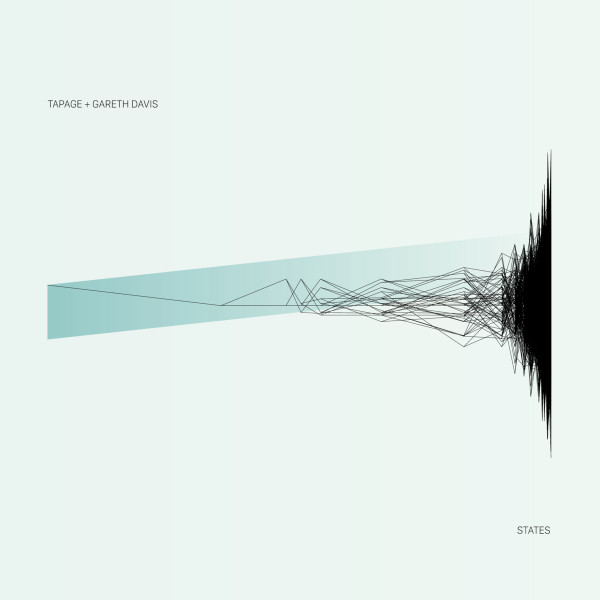
STATES started out as a live electronics setup, developed back in early 2016 by Tijs Ham. The first version combined analogue feedback with digital manipulations which resulted in a self-balancing and self-generating chaotic system, capable of producing deep, melodic and textured soundscapes. During a performance, the setup would be played until it would reach a state in which it was generating its own sonic material. The performer would then take a step back, allowing the system to run on its own. Carefully listening to the movements, progressions, noises, drones, and arpeggios until the urge to intervene took the upper hand and the system would be performed and nudged towards a new state of balance.
The STATES setup went through a series of revisions and alternative versions, each playing with the same basic ingredients, mixed up and prepared in various ways. In the summer of 2017, Tijs started to collaborate with Gareth Davis, well renowned for his work with contemporary and experimental music on the bass clarinet. During an inspired series of recording sessions at STEIM, the STATES setup was reinvented once again and lifted up through the spacious and engaging interplay between reed and recursion.
Recorded at STEIM
In the summer of 2017
Tijs Ham (Electronics)
Gareth Davis (Bass Clarinet)
Artwork by Tijs Ham
Mastered by Jos Smolders at EARLabs
Moving Furniture Records
This is release MFR074
www.movingfurniturerecords.com
https://gareth-davis.bandcamp.com/album/states
|
2019 |
€18.00 |
|